UNIT II DATABASE DESIGN
2.5 Functional Dependency
A functional dependency occurs when the value of one attribute (or a set of attributes) uniquely determines the value of another attribute. This relationship is denoted as:
X → Y
Here, X is the determinant, and Y is the dependent attribute. This means that for each unique value of X, there is precisely one corresponding value of Y.
Consider a table named Students with the following attributes:
StudentID | StudentName | StudentAge |
|---|---|---|
101 | Rahul | 23 |
102 | Ankit | 22 |
103 | Aditya | 22 |
104 | Sahil | 24 |
105 | Ankit | 23 |
The above table has the following functional dependencies
StudentID -> StudentName
StudentID -> StudentAge
Note that the functional dependencies StudentName -> StudentAge or StudentAge -> StudentName Do not hold.
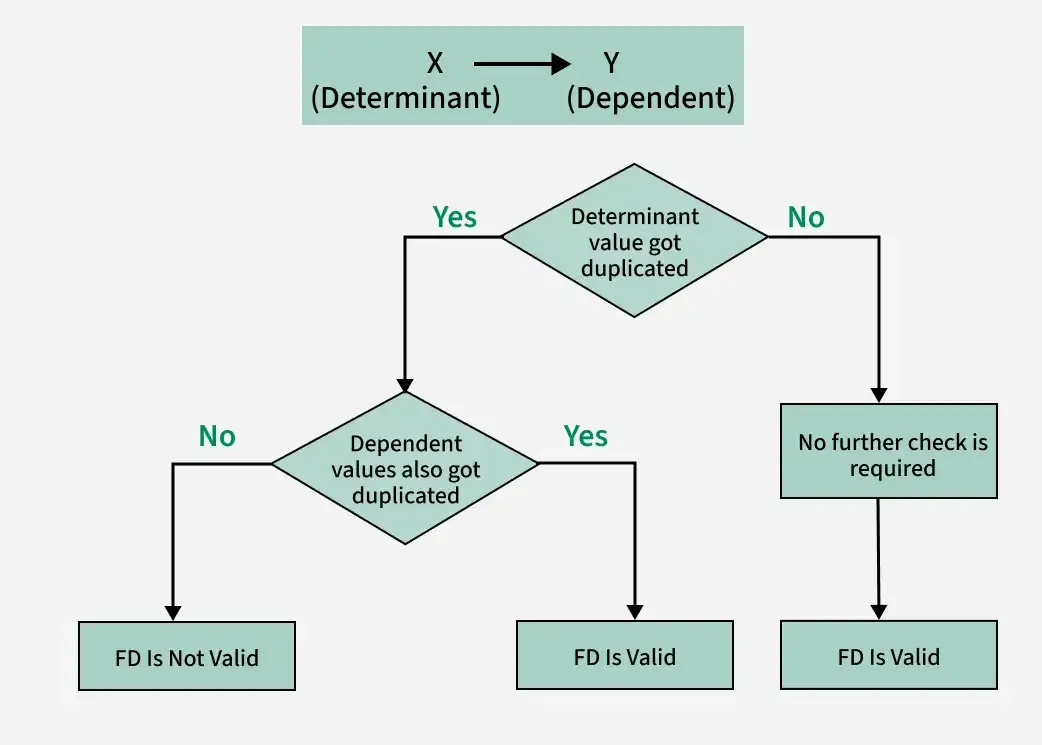
Types of Functional dependencies
A functional dependency occurs when one attribute uniquely determines another attribute within a relation. There are following types of functional dependencies.
1. Trivial Functional Dependency
In Trivial Functional Dependency, a dependent is always a subset of the determinant. i.e. If X → Y and Y is the subset of X, then it is called trivial functional dependency.
Symbolically: A→B is trivial functional dependency if B is a subset of A.
The following dependencies are also trivial: A→A & B→B
Example 1 :
- ABC -> AB
- ABC -> A
- ABC -> ABC
Example 2:
| roll_no | name | age |
|---|---|---|
| 42 | abc | 17 |
| 43 | pqr | 18 |
| 44 | xyz | 18 |
Here, {roll_no, name} → name is a trivial functional dependency, since the dependent name is a subset of determinant set {roll_no, name}. Similarly, roll_no → roll_no is also an example of trivial functional dependency.
2. Non-trivial Functional Dependency
In Non-trivial functional dependency, the dependent is strictly not a subset of the determinant. i.e. If X → Y and Y is not a subset of X, then it is called Non-trivial functional dependency.
Example 1 :
- Id -> Name
- Name -> DOB
Example 2:
| roll_no | name | age |
|---|---|---|
| 42 | abc | 17 |
| 43 | pqr | 18 |
| 44 | xyz | 18 |
Here, roll_no → name is a non-trivial functional dependency, since the dependent name is not a subset of determinant roll_no. Similarly, {roll_no, name} → age is also a non-trivial functional dependency, since age is not a subset of {roll_no, name}
3. Semi Non Trivial Functional Dependencies
A semi non-trivial functional dependency occurs when part of the dependent attribute (right-hand side) is included in the determinant (left-hand side), but not all of it. This is a middle ground between trivial and non-trivial functional dependencies. X -> Y is called semi non-trivial when X intersect Y is not NULL.
Example:
Consider the following table:
| Student_ID | Course_ID | Course_Name |
|---|---|---|
| 101 | CSE101 | Computer Science |
| 102 | CSE102 | Data Structures |
| 103 | CSE101 | Computer Science |
Functional Dependency:
{StudentID,CourseID}→CourseID
This is semi non-trivial because:
- Part of the dependent attribute (
Course_ID) is already included in the determinant ({Student_ID, Course_ID}). - However, the dependency is not completely trivial because {StudentID}→CourseID is not implied directly.
4. Multivalued Functional Dependency
In Multivalued functional dependency, entities of the dependent set are not dependent on each other. i.e. If a → {b, c} and there exists no functional dependency between b and c, then it is called a multivalued functional dependency.
Example:
bike_model | manuf_year | color |
|---|---|---|
tu1001 | 2007 | Black |
tu1001 | 2007 | Red |
tu2012 | 2008 | Black |
tu2012 | 2008 | Red |
tu2222 | 2009 | Black |
tu2222 | 2009 | Red |
In this table:
- X:
bike_model - Y:
color - Z:
manuf_year
For each bike model (bike_model):
- There is a group of colors (
color) and a group of manufacturing years (manuf_year). - The colors do not depend on the manufacturing year, and the manufacturing year does not depend on the colors. They are independent.
- The sets of
colorandmanuf_yearare linked only tobike_model.
That’s what makes it a multivalued dependency.
In this case these two columns are said to be multivalued dependent on bike_model. These dependencies can be represented like this:
Read more about Multivalued Dependency in DBMS.
5. Transitive Functional Dependency
In transitive functional dependency, dependent is indirectly dependent on determinant. i.e. If a → b & b → c, then according to axiom of transitivity, a → c. This is a transitive functional dependency.
Example:
| enrol_no | name | dept | building_no |
|---|---|---|---|
| 42 | abc | CO | 4 |
| 43 | pqr | EC | 2 |
| 44 | xyz | IT | 1 |
| 45 | abc | EC | 2 |
Here, enrol_no → dept and dept → building_no. Hence, according to the axiom of transitivity, enrol_no → building_no is a valid functional dependency. This is an indirect functional dependency, hence called Transitive functional dependency.
6. Fully Functional Dependency
In full functional dependency an attribute or a set of attributes uniquely determines another attribute or set of attributes. If a relation R has attributes X, Y, Z with the dependencies X->Y and X->Z which states that those dependencies are fully functional.
Read more about Fully Functional Dependency.
7. Partial Functional Dependency
In partial functional dependency a non key attribute depends on a part of the composite key, rather than the whole key. If a relation R has attributes X, Y, Z where X and Y are the composite key and Z is non key attribute. Then X->Z is a partial functional dependency in RDBMS.

Comments
Post a Comment